Technical study
This editorial study records a proposed direction, its assumptions, and the tradeoffs that would need validation during product discovery and engineering design.
Executive summary
Intellect is an AI workspace concept. This study outlines a possible retrieval-assisted workflow, with emphasis on permission checks, source traceability, evaluation, and review. It does not claim an implemented model integration or production AI system.
Context and background
Knowledge assistants can help people find and synthesize information, but an answer is only useful when its source material is permitted, relevant, and current. Model output alone cannot establish those properties.
The concept therefore treats access control and source evidence as core workflow requirements rather than optional interface details.
Problem statement
How can an assistant provide useful responses grounded in organizational knowledge while respecting each user's permissions and making uncertainty visible?
Goals and requirements
A responsible prototype would test a bounded set of workflows and include:
- Identity-aware source filtering before retrieval.
- Clear references from generated claims to retrieved materials.
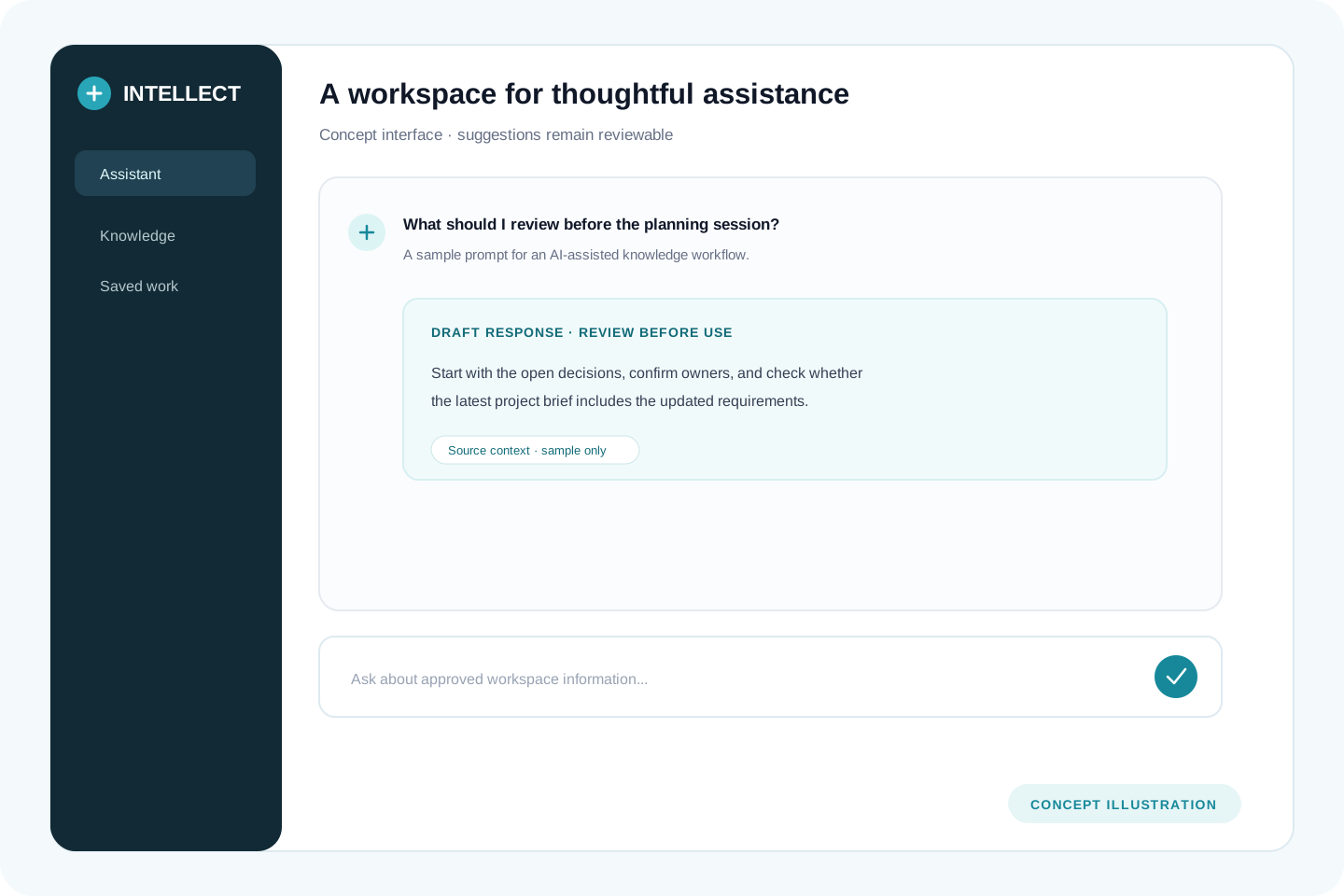
- A way to decline, correct, or escalate uncertain responses.
- Evaluation data that distinguishes retrieval quality from answer quality.
- Retention and provider controls aligned with the sensitivity of source content.
Solution approach
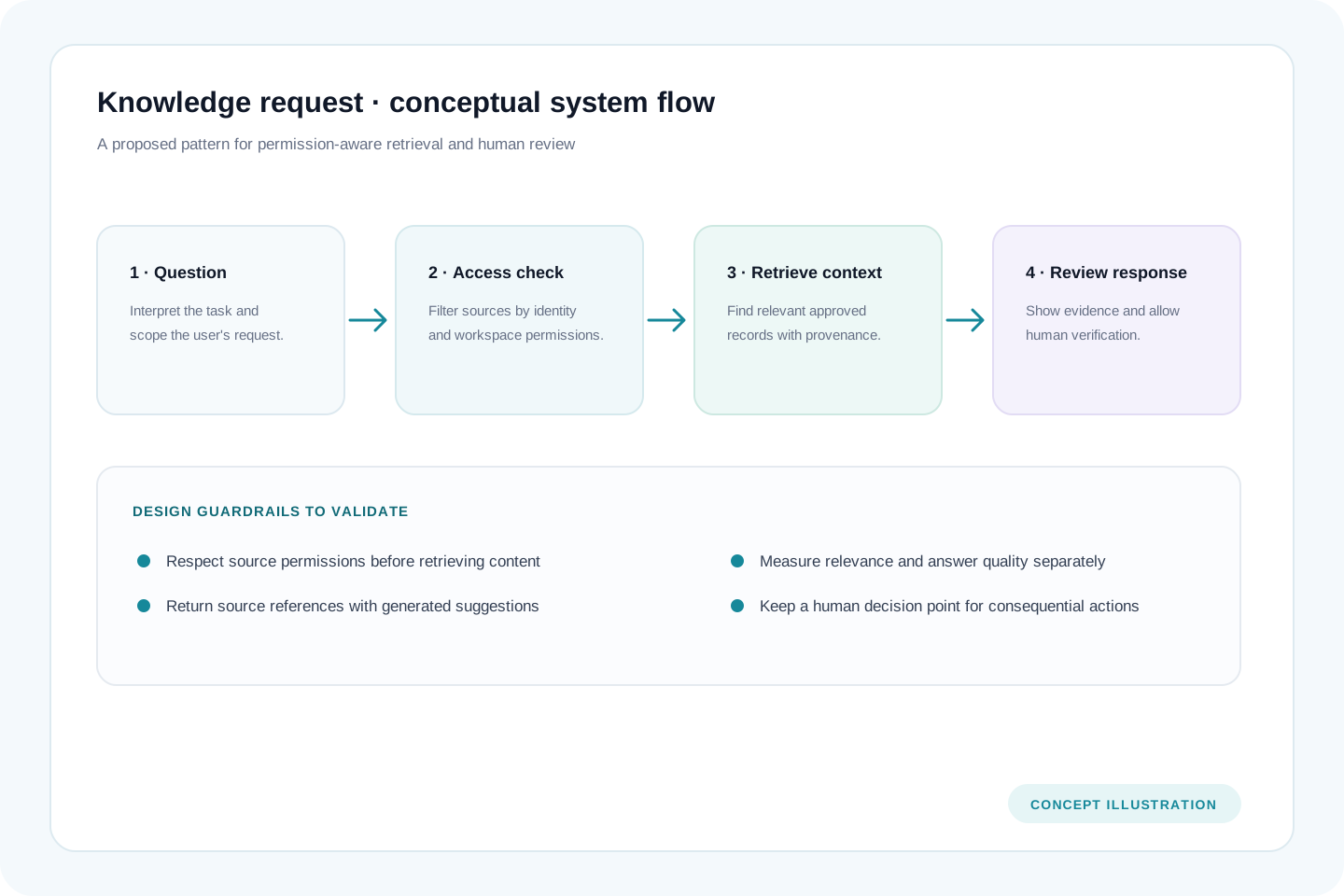
Use a staged pipeline: authenticate the user, resolve permitted sources, retrieve candidate passages, assemble a constrained prompt, generate a draft, and return citations with a confidence-aware review state. Keep each stage observable without logging sensitive content unnecessarily.
Begin with a limited corpus and explicit access model. Expand only after retrieval relevance, citation coverage, and failure behavior have been evaluated.
System architecture
A proposed system could use a web interface, an application service for identity and orchestration, a permission-aware retrieval layer, and a hosted model API. These are architectural options, not a verified implementation.
Document ingestion would need versioning, access metadata, deletion propagation, and a way to re-index changes. Any vector store is only one retrieval component and does not replace authorization or source-of-truth storage.
Technical implementation
Filter candidates by access before sending excerpts to a model. Preserve source identifiers and offsets with retrieved passages. Validate output shape, render citations separately from model prose, and provide a safe fallback when evidence is insufficient.
Engineering decisions
Separate retrieval evaluation from generation evaluation. Use a representative, permission-aware test set. Measure whether the right sources were found, whether claims are supported, and whether abstention works when evidence is missing.
Challenges and tradeoffs
More context can improve coverage but increase latency, cost, and exposure. Aggressive filtering protects boundaries but can omit relevant material. Model choice, retention, and deployment region require review against the data classification and operating constraints.
Outcomes and learnings
This is a technical blueprint, not a deployed AI feature. No accuracy, time-saving, or adoption outcome is claimed. The central design lesson is that permissions and evaluation must be built into the retrieval workflow from the beginning.
Visual explanations
Supporting concept visuals
These original diagrams and interface illustrations explain the proposed direction. They are not screenshots of a delivered system.
Engineering decisions
- Apply access filters before model context is assembled.
- Keep source references linked to each retrieved passage.
- Evaluate retrieval, answer support, and abstention as separate behaviors.
Tradeoffs to validate
- Larger context windows raise cost and exposure as well as coverage.
- More restrictive retrieval can reduce leakage risk but may miss useful material.
Outcomes and learnings
No verified outcomes are available for this proposed study. A vector index is not an authorization system. Citation presence alone does not prove an answer is supported.