
Technical study
This editorial study records a proposed direction, its assumptions, and the tradeoffs that would need validation during product discovery and engineering design.
Executive summary
Marketly is an illustrative commerce concept. This blueprint describes how a product team could reason about browsing, cart state, order records, and operator workflows; it does not claim that a store or transaction system was built.
Context and background
A commerce experience joins customer-facing discovery with operational concerns such as inventory, payment state, fulfilment, and support. A polished storefront is only one part of that system.
The concept visuals are illustrative. A real solution would depend on the merchant's catalog, payment provider, fulfilment model, and existing systems.
Problem statement
How might a product make it easy to find and evaluate products while giving operators a dependable view of each order's state?
Goals and requirements
A proposed discovery phase would verify the business rules before implementation. Initial product requirements could include:
- Search and browse a catalog with useful product attributes.
- Represent cart and checkout state clearly across the customer journey.
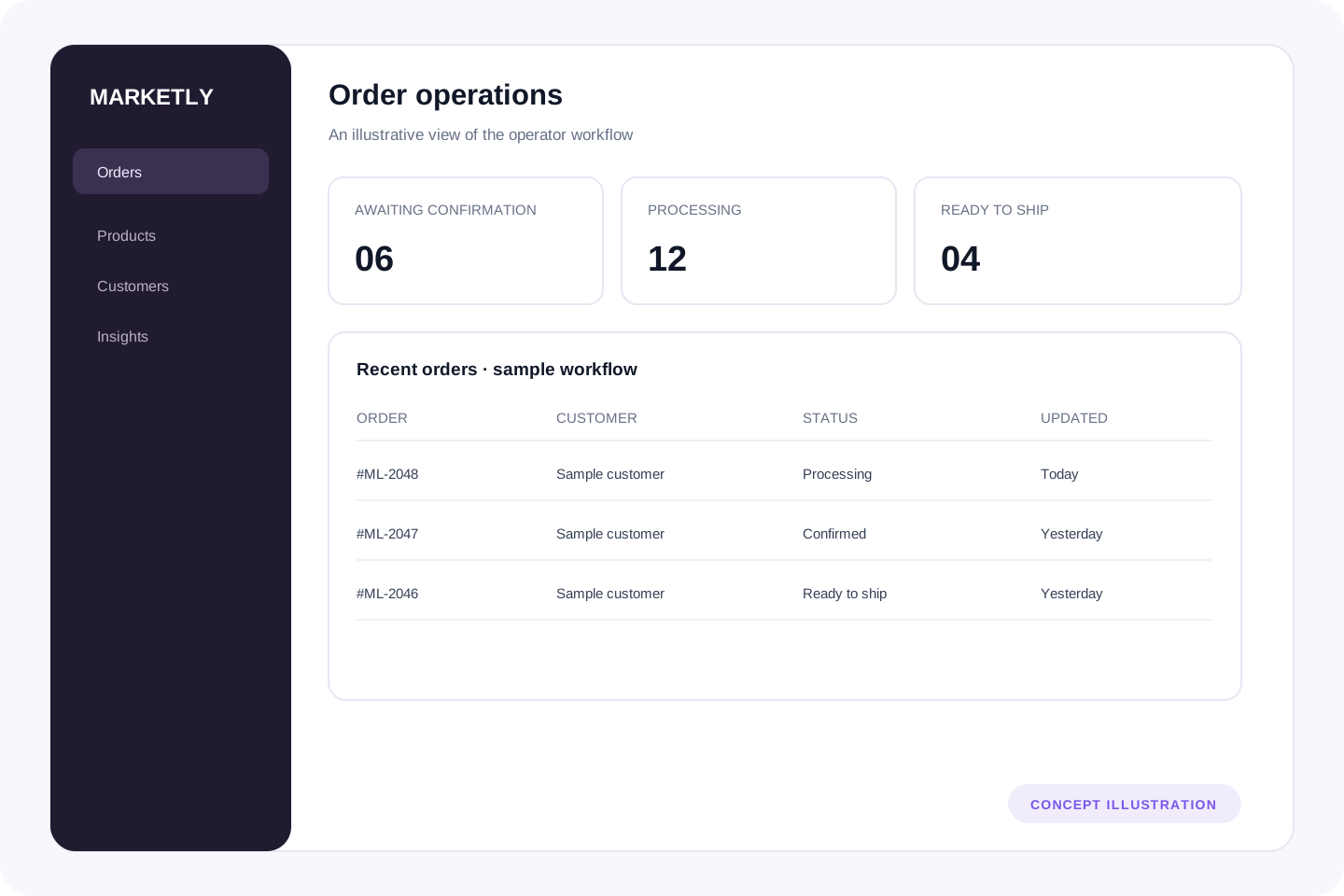
- Keep order status consistent between customer and operator views.
- Make payment and fulfilment dependencies explicit rather than implying they are built in.
Solution approach
Treat catalog browsing, cart management, checkout orchestration, and order operations as separate but connected capabilities. Define the order lifecycle first, then design the interfaces around valid state transitions.
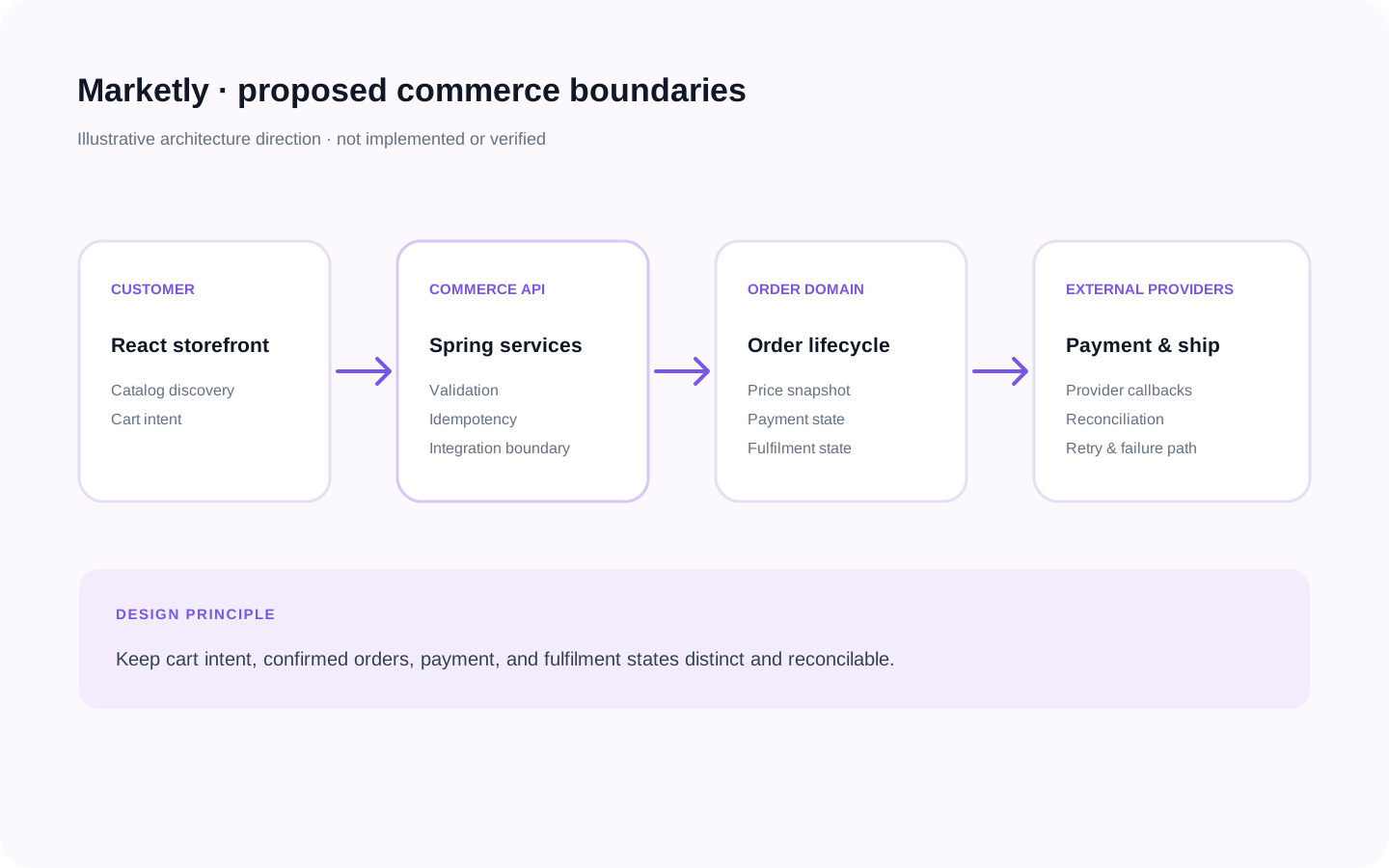
Keep external payment and fulfilment integrations behind explicit boundaries so their failure and retry behavior can be designed and tested independently.
System architecture
A possible implementation could pair a React storefront with a Java/Spring API and a document store where the catalog shape and access patterns justify it. The technology labels are illustrative; no deployed stack is verified.
The data model should separately account for catalog products, price snapshots, carts, orders, payment references, and fulfilment updates. Final persistence choices depend on transaction and reporting needs.
Technical implementation
Use server-side validation for order creation, idempotency for checkout requests, and explicit payment states for pending, authorized, failed, and refunded cases. Keep a stable order identifier so asynchronous provider updates can be reconciled safely.
Engineering decisions
Separate a customer's cart intent from a confirmed order. Snapshot prices and product descriptions at checkout to preserve what was purchased. Define how inventory reservation behaves before accepting concurrent orders.
Challenges and tradeoffs
A flexible catalog supports varied products but complicates filtering and validation. Strong consistency around checkout protects order integrity but can reduce throughput. The correct tradeoff depends on catalog complexity and purchase patterns.
Outcomes and learnings
This is a solution blueprint for a concept, not a completed commerce system. There are no verified conversion, revenue, or fulfilment results. The core learning is to model order lifecycle and integration boundaries before polishing storefront interactions.
Visual explanations
Supporting concept visuals
These original diagrams and interface illustrations explain the proposed direction. They are not screenshots of a delivered system.
Engineering decisions
- Snapshot price and item details at order creation.
- Keep checkout idempotent and provider callbacks reconcilable.
- Represent fulfillment and payment as separate state machines.
Tradeoffs to validate
- A flexible catalog model requires stronger validation and indexing discipline.
- Synchronous inventory checks simplify checkout but require clear behavior under contention.
Outcomes and learnings
No verified outcomes are available for this proposed study. Customer checkout and operator order management share one lifecycle model. Third-party integrations need explicit retry and reconciliation paths.